

A Learning Tool Used by Millions Faces Questions About Evidence—and a Lawsuit
Is i-Ready running consumer tech's predatory playbook in public schools?

I worked at Meta for nearly 15 years, including as Director of Product Marketing where I witnessed harm to kids and was retaliated against for raising concerns, causing a functional loss that I am still recovering from. I am a federal whistleblower, advocate for legislative reform to protect kids online, and my lawsuit against Meta is active in federal court. I write this Overturned newsletter on tech accountability and broken systems of power.
A 10-year-old fourth grader from Normandy Park, WA, could not be more excited to pull up the education technology platform her school mandates. “I love i-Ready,” says Sophia (note: name changed for privacy) with bright blue, full-moon-eyes, before listing off her favorite characters in the software, “Plory is an orange alien, Yoop Yooply is green.”

She’s looking at an expanded form of a four-digit number, and the software directs her to write the individual place value in boxes labeled “thousands,” “hundreds,” “tens,” and “ones.” Incorrect answers are highlighted but not explained, so Sophia tries several different numbers until she’s allowed to continue. When she answers correctly, she moves on to another question.
Behind the colorful animations and alien friends, behind the bar charts showing how many minutes Sophia has logged this week, bigger, more existential questions are being asked of the digital assessment and instruction platform used by more than 13 million K-8 students like Sophia across the United States.
With $775 million in annual revenue largely generated from taxpayer-funded school districts, i-Ready is marketed by its parent company, Curriculum Associates, as a tool that accelerates student growth and improves outcomes. Curriculum Associates says the program provides personalized instruction based on student performance and collects data to support learning.
For many families and kids like Sophia, i-Ready is simply part of the school day. For others, it has become a source of concern, not just about how well it supports learning and assessment, but what it collects in the process.
Districts often adopt tools like i-Ready to provide consistent assessments across classrooms and to help students meet grade-level standards. But independent research on its effectiveness is limited, and a new federal lawsuit alleges that the system collects vast personal data on the kids who use it, then shares that data with third parties without parental consent.
The class action lawsuit brought by lead plaintiffs and California online safety advocates, Nicole Reisberg (Nicki Petrossi) and Lila Byock, each on behalf of their children, was filed in December and alleges i-Ready collects detailed behavioral, demographic, and technical data on students, including interaction patterns and inferred performance metrics, and shares or uses that data in ways not adequately disclosed, including for commercial purposes. Together with their lawyers, they explicitly monitored HTTP traffic and watched the actual requests generated when kids used i-Ready.
“When a student interacts… information… is… instantaneously transmitted to third parties,” the complaint says, including advertising companies, marketing companies, and identity-resolution companies. They assert these practices are in violation of several consumer protection, invasion of privacy, and unjust enrichment laws.
“Parents want to know what data is being taken about their child,” Petrossi told me, “Dozens if not hundreds of parents have reached out to Curriculum Associates to request their child’s data. Many of them have told me that the company has denied their request. Parents are being given the run-around and we are not OK with that.”
The company disputes the lawsuit’s allegations and says it does not sell student data or use it for advertising. In a February Motion to Dismiss, i-Ready asserted the claims were legally insufficient and “seek to destroy a longstanding regulatory framework that allows schools to consent to EdTech providers’ collection of student data in the classroom.” Plaintiffs and their lawyers filed a response to i-Ready’s Motion to Dismiss last month.
Emily Cherkin, a former middle school teacher, left the classroom and became an educational consultant and author after seeing firsthand the impact of EdTech at school. Cherkin filed a lawsuit in 2024 against a different EdTech platform, PowerSchool, alleging they collect data, sell it, and expose children to risk online.
“Lo and behold, six months later PowerSchool experienced a massive data breach,” she said.
“Tools like i-Ready make kids and parents way more anxious and obsessed about the wrong things and forces teachers to think about learning and progress as a quantifiable sum when neither children nor teachers are standardized,” Cherkin told me, “I reject the use of products like i-Ready whose business model relies on data collection of minors without parental consent for profit. That is fundamentally out of alignment with child development.”
While the evidence section of i-Ready’s website includes studies detailing how it improves learning outcomes and accelerates student growth through personalized instruction, none of these studies are peer-reviewed, and there have been zero randomized controlled trials. The evidence listed is largely made up of white papers commissioned by i-Ready directly and studies without control groups.
Erin Ambrozic is the PTSA president at Sophia’s school and the mom of one of her classmates. She has raised concerns about i-Ready to her daughter’s teachers over the past four years as well as to her principal several times to better understand i-Ready’s effectiveness. “My daughter has received inconsistent scores every year across fall/winter/spring diagnostics, oscillating from exceeding to below grade level, then back to exceeding or at grade level, in a pattern and across a timeline where, were i-Ready truly effectively measuring her growth over the school year, it would mean she was actually getting less educated throughout each school year.”
A 2025 study found i-Ready’s trimester-based assessments less predictive than traditional end-of-year state standardized assessments of whether or not a student would pass the next year’s standardized assessment.
“I’ve spent time on the platform myself from the student side at home, and I don’t find it particularly intuitive or clearly aligned with classroom instruction,” said Ambrozic, “I actually think it’s a very poor use of student time.”
Another parent at Sophia’s school who has been questioning i-Ready, Becky Heinle, a mother of three, said, “Every teacher I have raised concerns with since first grade has told me not to be concerned with the results.”
Dr. Jared Cooney Horvath, a former teacher and neuroscientist who focuses on learning and recently testified on education technology alongside Cherkin before the United States Senate, dug deep into i-Ready’s body of evidence, concluding he could find “zero meaningful evidence” demonstrating its effectiveness. He notes that i-Ready advocates often point to two studies from the Johns Hopkins School of Education on reading and math that Curriculum Associates lists on their website.
“Both studies were conducted in partnership with Curriculum Associates, the developer of i-Ready. Both were released as white papers, meaning they were not peer-reviewed,” Dr. Horvath wrote.
Peer review and controlled trials help us distinguish between something that works and something that merely claims to. A peer-reviewed study has been scrutinized by independent experts before publication. A randomized controlled trial compares outcomes between students who use a tool and students who don’t, under conditions designed to rule out other explanations. Without these safeguards, a company can fund its own research, design studies that favor its product, and publish the results without anyone independently checking the methodology.
“The name ‘Johns Hopkins’ carries weight, however, so it’s worth examining what they actually found,” Dr. Horvath wrote. Their results? The researchers concluded that there were no statistically significant associations between i-Ready use and student outcomes in reading. In math, researchers reported a difference between i-Ready users and the control group of less than one percent.
“Across grades, students using i-Ready improved by 7.8%, while students not using it improved by 7.0%, a difference of less than one percentage point,” Dr. Horvath explains, “In a sample of 7,646 students, at roughly $70 per student, that amounts to over $535,000 spent on i-Ready to achieve a 0.8% difference in mathematics performance, with no measurable change in reading.”
The absence of strong independent evidence does not necessarily mean a tool is ineffective, but it does make its impact harder to evaluate. Curriculum Associates, along with several teachers and school administrators featured in i-Ready’s case studies and marketing materials, did not respond to my requests for comment on either the lawsuit or Dr. Horvath’s review.
But they’re responding to the influx of criticism in other ways.
John Allen Wooden, a Los Angeles writer and dad who started investigating i-Ready after witnessing his son’s experiences first-hand, noticed last month that i-Ready was buying ads on Google against his name, headlining the ad, “The Real Facts About i-Ready.”
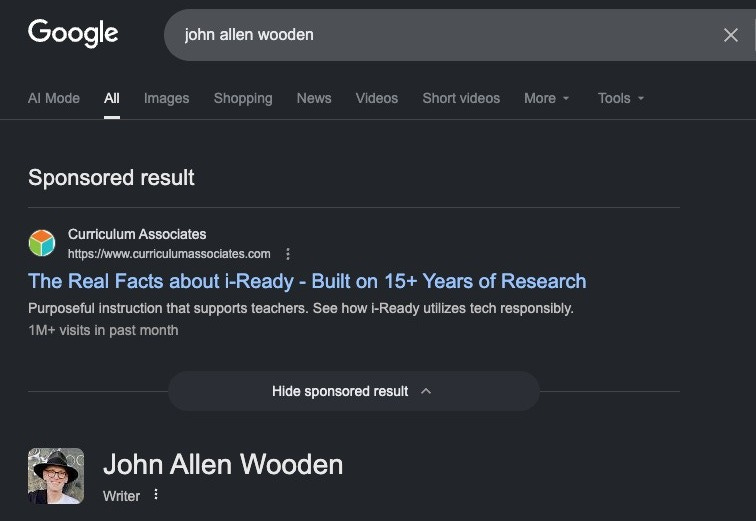
“At first I thought it might be a glitch, so I reached out to contacts elsewhere in the country and got confirmation from both Alaska and NYC that they were seeing the same thing when they searched my name. So I promptly posted it online and tagged Curriculum Associates. The ad stopped running within 12 hours after I exposed it,” Wooden told me.
Wooden’s research into the platform began last year when his middle school son began complaining about i-Ready. With a thirty-year career in online media and internet product development, Wooden has experience with producing quality digital experiences.
“I was first struck by how dreadfully poor the design and performance was: slow, repetitive, and aesthetically age-inappropriate, with infantile cartoon characters delivering questions to a tween whose favorite movie is Aliens. Then I quickly noticed that the educational content therein was equally poor; with many questions having confusingly ambiguous phrasing, typos, and indicating “correct” answers that were quite simply wrong. Worst of all, the mandate for students wasn’t to successfully complete lessons or reach any mastery milestones, it was merely to spend a fixed number of minutes engaging with the platform.”
All of the teachers interviewed for this article described school or district-level minutes requirements. “I don’t know that we should be giving 5-year-olds iPads and requiring them to spend time there during the school day,” said a Washington state kindergarten teacher who asked to remain anonymous.
The basis for the minimum minutes recommendation? A 2021 study paid for and executed by Curriculum Associates.
The next time Wooden’s son had a group of friends over, he asked them what they thought of i-Ready. “My question was met with a chorus of boos and furious denunciations.”
“My curiosity was piqued. I started researching the program, and was shocked to discover how massive its footprint is within US schools, how virtually no legitimate studies support it and how it had received effectively zero press scrutiny,” said Wooden, who has begun publishing a six-part investigation into what he’s uncovered, “As someone who knows all too well how the digital media sausage is made, I could discern the sophisticated techniques Curriculum Associates was using to deploy a digital smokescreen of internally produced, officiously packaged, SEO’ed ‘research’ that was dominating search results for anyone attempting due diligence.”
Curriculum Associates has ignored every email Wooden has sent to their publicly listed press email address, Wooden says.
Young people sent reactions directly to Petrossi after she went public about filing suit against Curriculum Associates. She shared some of their responses on Instagram, which are largely expressions of gratitude as well as comments like “...I HAVE DEPRESSION BECAUSE OF THAT APP…” and “...YOU’VE JUST SAVED ME…”

And it’s not just students who have been sending Petrossi feedback. “Teachers have reported that they are being forced to use i-Ready,” she said.
“Districts are mandating a certain amount of time students need to do i-Ready,” a Los Angeles teacher told Petrossi in a screenshot shared with me “90 minutes a week on i-Ready is more important than instruction from a teacher in the eyes of the district.”
“We just had a very dedicated, hardworking, and passionate young teacher fired because her students didn’t show enough growth on their i-Ready diagnostics,” explained a sixth grade math teacher to Petrossi in another screenshot shared with me, “She was fired 3 weeks prior to doing her tenure presentation.”
While Petrossi and Byock’s lawsuit focuses on data practices, it intersects with a broader question: if the educational benefits of the platform are not clearly established through independent research, what justifies its widespread use?
i-Ready’s alleged practices mimic a predatory dynamic in consumer tech that schools may be unintentionally replicating: high data extraction, limited transparency, weak independent evidence of benefit, and adoption ahead of safeguards and testing.
Could the hundreds of thousands of dollars that school districts spend on i-Ready be better spent on proven interventions, such as hiring reading/math interventionists, reducing class sizes, and/or funding targeted tutoring blocks?
“To be fair to Superintendents and School Boards, Curriculum Associates has targeted them for years with a highly sophisticated lobbying and misinformation campaign that convinced them they were licensing a quality, proven-effective product,” said Wooden, “It is not quality. All the supporting data is self-dealing black box junk. It doesn’t work.”
Back in Normandy Park, Sophia doesn’t know about the lawsuit, or the studies, or the fired teacher in New York. A half hour into the lesson, it’s also unclear whether she understands the concept of place value. But she knows Plory is orange and Yoop Yooply is green, and she knows she needs to finish her minutes.
Practical Resources:
Lead plaintiff in the class action, Nicki Petrossi, published a guide for contacting your schools and school boards here.
Copies of the emails I wrote to my Superintendent and school board, as well as an email I wrote to other parents who might be interested in staying informed and organizing here.
Webinar May 21, 12pm PST: Join Jodi Carreon (Schools Beyond Screens) in conversation with lead plaintiffs Lila Byock (Schools Beyond Screens) and Nicki Petrossi (Scrolling2Death) and attorney Andrew Liddell (EdTech Law Center) to discuss the allegations in the case and answer frequently asked questions from the public. Register here.
"A half hour into the lesson, it’s also unclear whether she understands the concept of place value. " Sums it all up so well! What a terrifying landscape.
Would love if you could also investigate the company behind IXL. My kid’s school uses that and it is such a source of anxiety for him. And it’s required. We have very similar complaints to what you’ve shared here about this platform.